

ICEECE2012 Poster Presentations Thyroid cancer (108 abstracts)
Thyroid paraganglioma. Report of 3 cases and description of an immunohistochemical profile useful in the differential diagnosis with medullary thyroid carcinoma, based on complementary DNA array results
E. Castelblanco 1, , P. Gallel 1, , S. Ros 1, , S. Gatius 1, , J. Valls 1, , A. De-Cubas 4 , A. Maliszewska 4 , M. Yebra-Pimentel 5 , J. Menarguez 6 , C. Gamallo 7 , G. Opocher 8, , M. Robledo 4, & X. Matias-Guiu 1,
Centro de Investigación Biomé dica en red de enfermedades raras, Madrid, Spain.
Thyroid paraganglioma (TP) is a rare disorder that sometimes poses problems in differential diagnosis with medullary thyroid carcinoma (MTC). So far, differential diagnosis is solved with the help of some markers that are frequently expressed in MTC (TTF1, calcitonin, and CEA). However, some of these markers are not absolutely specific of MTC and may be expressed in other tumors. Here we report 3 new cases of TP and describe our strategy to design a diagnostic immunohistochemical battery.
First, we performed a comparative analysis of the expression profile of head and neck paragangliomas and MTC, obtained after complementary DNA array analysis of series of fresh-frozen samples of paragangliomas and MTC, respectively. Seven biomarkers showing differential expression were selected (NDUFA4L2; COXIV2; VMAT2; CGRP/calcitonin; CEA; and TTF1) for immunohistochemical analysis. Two tissue microarrays were constructed from 2 different series of paraffin-embedded samples of paragangliomas and MTC.
We provide a classifying rule for differential diagnosis that combines negativity or low staining for CGRP (histologic score, <10) or calcitonin (histologic score, <50) together with positivity of any of NDUFA4L2; COXIV2; or VMAT2 to predict paragangliomas, showing a prediction error of 0%. Finally, the immunohistochemical battery was checked in paraffin-embedded blocks from 4 examples of TP (1 previously reported case and 3 new cases), showing also a prediction error of 0% (Default 1).
Our results suggest that the comparative expression profile, obtained by complementary DNA arrays, seems to be a good tool to design immunohistochemical batteries used in differential diagnosis.
| Antibody | TMA MTC Hscore, Mean Range | TMA PGL Hscore Mean Range | Case 1 Hscore | Case 2 Hscore | Case 3 Hscore | Case 4 Hscore |
| Anti-NDUFA4L2 | 149 (100 –206) | 215 (112 –285) | 250 | 195 | 210 | 240 |
| Anti-COXIV2 | 126 (15 – 165) | 154 (101 260) | 220 | 210 | 250 | 210 |
| Anti-VMAT2 | 83 (20 – 100) | 98 (0 – 130) | 170 | 140 | 170 | 170 |
| Anti-CGRP | 242 (70 – 296) | 0.97 (0 – 7.5) | 0 | 0 | 0 | 0 |
| Anti-calcitonin | 253 (168 – 295) | 1.7 (0 – 40) | 0 | 0 | 0 | 0 |
| Anti-TTF1 | 72 (0 – 205) | 0 (0 – 0) | 0 | 115 | 0 | 0 |
| Anti-CEA | 150 (0 – 295) | 0 (0 – 0) | 0 | 0 | 0 | 0 |
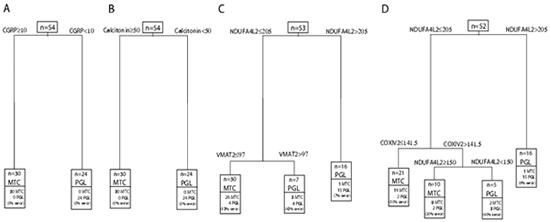
Classification trees to predict tumor type, based on immunohistochemical features of the potential biomarkers. Prediction error is shown for each terminal node and globally for each tree.
Declaration of interest: The authors declare that there is no conflict of interest that could be perceived as prejudicing the impartiality of the research project.
Funding: This work was supported, however funding details unavailable
Article tools
My recent searches
My recently viewed abstracts
Authors

Endocrine Abstracts
ISSN 1470-3947 (print) | ISSN 1479-6848 (online)
© Bioscientifica 2024 |
Privacy policy |
Cookie settings
BiosciAbstracts

Bioscientifica Abstracts is the gateway to a series of products that provide a permanent, citable record of abstracts for biomedical and life science conferences.
Find out more